Which portfolio and custody platforms will actually give you your data
Some platforms hand your firm a key. Some issue it to a partner instead. Some take weeks and a named signer. The difference decides whether a job is two hours a month or impossible.
9 August 2026 · 6 min read
Your firm, and your firm can revoke it
A partner. Tamarac runs through Envestnet
Your firm, via a signer on Form ADV Schedule A
Band four, and it is not a queue
The position is struck at the mark. Nothing has gone wrong and nothing is late; between marks there is no file to reconcile against.
Reconcile what exists · carry the rest at the last mark, and say so
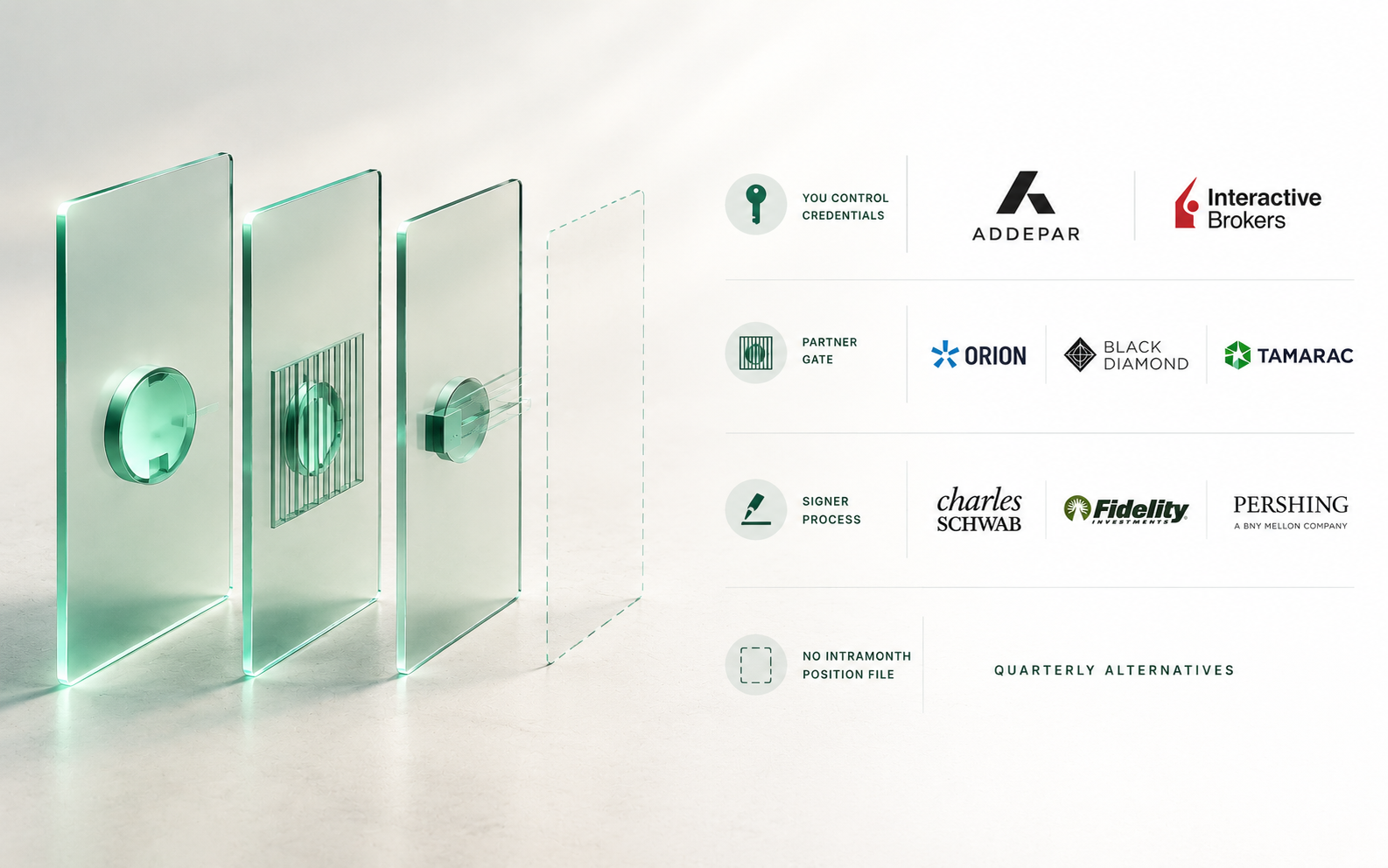
An access register for portfolio and custody platforms, in four bands. Band one, Addepar and Interactive Brokers Flex, issues a credential your firm holds and can revoke, in days. Band two, Orion, Black Diamond and Tamarac, issues it to a partner, with Tamarac running through Envestnet, so there are two approvals rather than one. Band three, Schwab, Fidelity and Pershing, issues it to your firm through a signer validated on your Form ADV Schedule A, and takes weeks. Band four, holdings marked quarterly, has no holder at all: there is no intramonth position file, because the position is only struck at the mark, so the correct answer is to reconcile what exists and carry the rest at the last mark.
4 bands, 1 with no file at all
Nine named platforms, three different answers to who holds the credential, and one case where the file a reconciliation runs against is never written between marks.
The band decides the work before anyone looks at the work, and no amount of effort moves a firm up one.
Short answer
Access falls into four bands. Addepar and Interactive Brokers issue credentials your firm genuinely controls. Orion, Black Diamond and Tamarac have documented APIs behind a partner gate, where the credential goes to the partner, not to you. Schwab, Fidelity and Pershing do have a path. It runs through a signer validated against your Form ADV Schedule A and takes weeks. Alternatives marked quarterly have no intramonth position file at all. Between marks there is nothing to reconcile against.
Why platform access decides the work before anyone looks at the work
Every operational job in a fund or advisory firm rests on getting a position file and a transaction file out of the system that holds them. Reconciliation, performance reporting, fee billing and most of what an auditor asks for are all downstream of that one question. If the file arrives on a schedule, the job is small and repeatable. If it does not, no amount of process design fixes it.
Ask it on the first call. It is the question most often answered with optimism. A platform having an API does not mean your firm can use it. A platform having no API does not always mean the data is unreachable. The distinction is who the credential is issued to, and it is not visible from a documentation page.
| Band | Platforms | Who holds the credential | Realistic setup |
|---|---|---|---|
| One | Addepar, Interactive Brokers Flex | Your firm, and your firm can revoke it | Days |
| Two | Orion, Black Diamond, Tamarac | A partner. Orion issues them; Tamarac runs through Envestnet | Two approvals, not one |
| Three | Schwab, Fidelity, Pershing | Your firm, via a signer validated on Form ADV Schedule A | Weeks |
| Four | Holdings marked quarterly | Nobody. No intramonth file exists | Not applicable |
Band one: a key your firm actually controls
Addepar and Interactive Brokers, through its Flex queries, issue credentials that are genuinely firm-issued or portable. Your firm creates the access, your firm holds it, and your firm can revoke it. Nobody else has to agree.
This is the band where automation behaves the way people assume it does everywhere. A scheduled pull runs, the file lands, and the reconciliation happens against it. Setup is measured in days and the failure modes are ordinary: an expired credential, a changed report definition, a multi-factor prompt nobody expected.
Band two: a documented API behind a partner gate
Orion, Black Diamond and Tamarac publish APIs, and reading the documentation gives the strong impression that access is available to anyone who asks. It is not available to you in the way it looks.
The credential is issued to a PARTNER, not to your firm. Orion issues them; Tamarac runs through Envestnet. So there are two gates rather than one: the provider has to approve the partner, and you have to approve the partner acting on your data. Both take time, and either can decline.
The practical consequence is that a working integration here is a commercial arrangement before it is a technical one. If somebody tells you this is a one-afternoon setup because the endpoint is documented, they have read the documentation and not attempted the access.
Band three: custodians, where the path exists and takes weeks
Schwab, Fidelity and Pershing are widely described as closed. That is not accurate, and getting it wrong in the pessimistic direction costs firms real capability.
There is a path. It runs through a signer validated against your firm's Form ADV Schedule A, which means the person authorising the connection has to be someone the custodian can verify as a control person of the adviser. That is a document check, a compliance step and a queue, so it is measured in weeks rather than days.
The implication for planning is simple and rarely stated: start this early. It is the longest lead time in an operational build. Almost nobody starts it first; most firms begin once everything else is ready.
Band four: no file exists at all
Alternatives marked quarterly are the case nobody plans for. There is no intramonth position file, because the position is only struck at the mark. Nothing has gone wrong; the data simply does not exist between marks.
No integration, no tooling and no vendor changes this. Reconciliation between marks is not slow here, it is undefined, and the correct answer is to reconcile what can be reconciled and to be explicit in reporting about what is carried at the last mark.
A provider who promises monthly reconciliation across a portfolio containing quarterly-marked alternatives either has not read the portfolio or is describing something other than reconciliation.
The questions that settle it in one call
Four questions establish which band a firm is in. Ask them before the scoping conversation, not after it.
What holds the positions, and on which plan? Plan tier decides API availability at several providers, and a firm on a lower tier can be told an integration exists that their own subscription does not include.
Who at the firm can authorise an integration, and are they on Schedule A? If the answer is an operations manager who is not a listed control person, the custodian path needs a different signer and that changes the timeline.
Is there multi-factor authentication, and who holds the second factor? A scheduled pull that requires a code from one person's phone is not a scheduled pull.
Are any holdings marked quarterly? If so, name them before designing anything that assumes a monthly file.
| Ask | What a bad answer sounds like | Why it matters |
|---|---|---|
| What holds the positions, and on which plan? | The platform name with no tier | Plan tier decides API availability at several providers |
| Who can authorise an integration? | An operations manager | The custodian path needs a control person listed on Schedule A |
| Is multi-factor on, and who holds it? | One named person's phone | A pull that needs a code from someone's phone is not scheduled |
| Anything marked quarterly? | We will check | It changes what can be promised, not how the work is done |
What to do with the answer
Band one means the work is small and can be scheduled. Band two means budget for a commercial conversation and do not promise a date until the partner has agreed. Band three means start the paperwork now and design an interim process for the weeks in between. Band four means adjust what is being promised, not how hard anyone is working.
The honest version of this is worth more than an optimistic one on the first call. A firm that hears which band it is in can plan; a firm that hears yes to everything finds out in month two, and by then the plan is already built on it.
Questions people ask
- Does a platform having an API mean I can automate against it?
- No. The question is who the credential is issued to. Addepar and Interactive Brokers issue access your firm controls. Orion, Black Diamond and Tamarac publish APIs, but the credential goes to a partner. That means two approvals, and either one can decline.
- Can I get data out of Schwab, Fidelity or Pershing?
- Yes, and the common claim that you cannot is wrong. The path runs through a signer validated against your firm's Form ADV Schedule A, so the person authorising it must be verifiable as a control person of the adviser. Plan for weeks, not days, and start it before the rest of the build.
- Why can nobody reconcile my alternatives monthly?
- Because for holdings marked quarterly there is no intramonth position file to reconcile against. The data does not exist between marks. The correct approach is to reconcile what exists and to state clearly in reporting what is carried at the last mark.
- What should I ask a provider before signing anything?
- What holds the positions and on which plan, who at your firm can authorise an integration and whether they are on Schedule A, whether multi-factor is enabled and who holds the second factor, and whether any holdings are marked quarterly. Those four answers decide whether the work is two hours a month or not possible as described.
- Who owns the credentials once an integration is running?
- Your firm should, in every band where it is possible. Access is added to systems you already run, and nothing moves to a provider. Where a partner gate makes that impossible, the arrangement should be written down and understood before it is relied on.
- Written from
- Trestora's operating doctrine, section 2: custodian and portfolio reconciliation
- Published API documentation from Addepar, Interactive Brokers, Orion, Black Diamond and Tamarac
- Schwab, Fidelity and Pershing data access requirements, including signer validation against Form ADV Schedule A
- Our own access attempts on each platform named, not the documentation alone
- Last checked
- 9 August 2026
- What this does not cover
- Pricing, contract terms and which plan tier includes what, all of which move per firm and per renewal. Nor any platform we have not attempted access to ourselves: absence from this guide means untested, not rejected.
Run it or build it. Both start here.
Join the waitlist.
We are taking a small number of firms to begin with. Leave your email and we will come back with what we would handle, on what cadence, and what it costs.